
























© 2025 Gurusisya Chess Academy. Designed by Caseyug Groups.
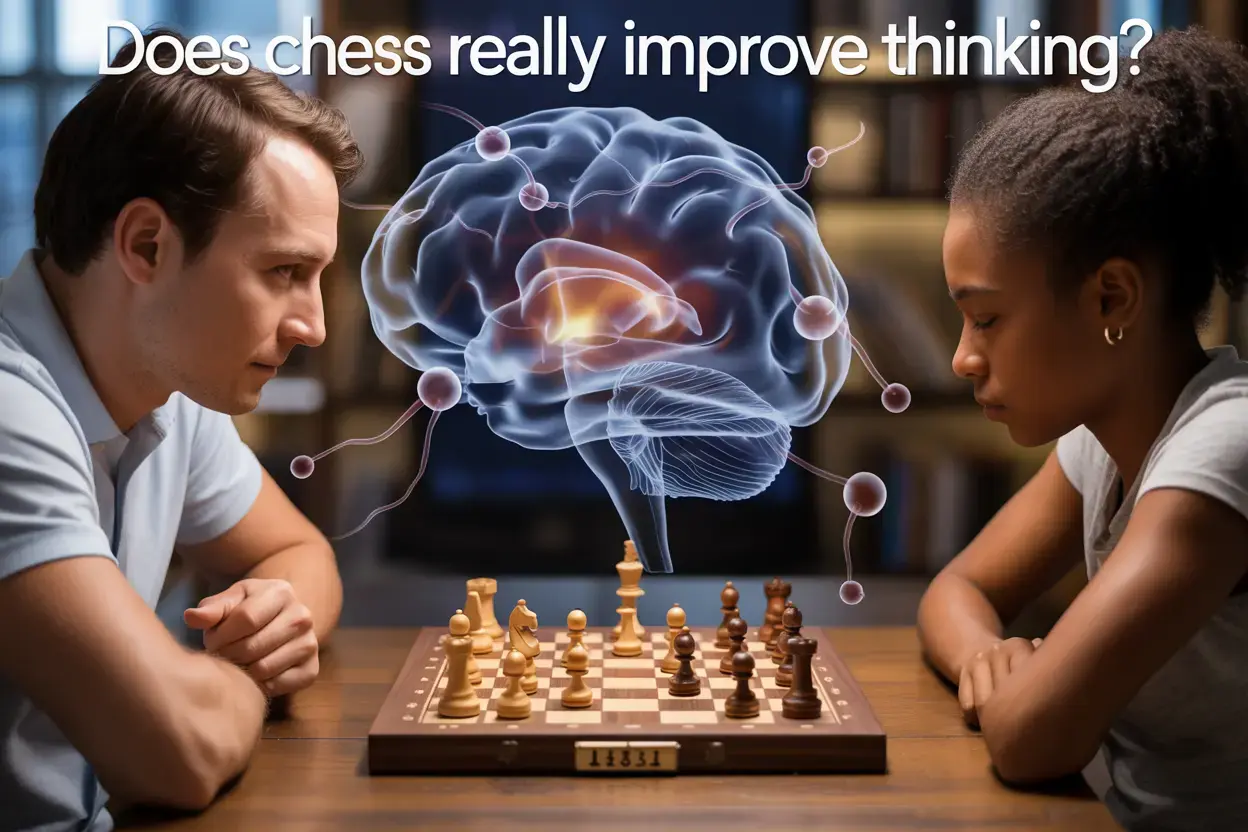
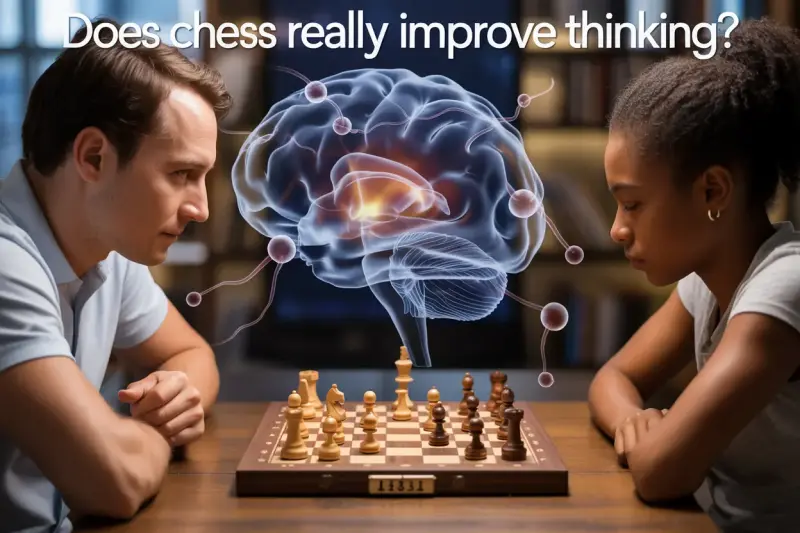
You may have heard the popular argument that playing chess makes you smarter. But does chess really improve cognitive functions as much as chess enthusiasts would like you to believe? This is an important debate for parents who are considering chess lessons for their children, adults who are interested in cognitive enhancement, and educators who are considering chess programs for their students.
Scientists have been studying the link between chess and cognitive benefits for decades, and what they found is that it is more complex than what is reported by media outlets. There are some findings that suggest chess-related thinking skills may be beneficial, but how far these benefits extend is debatable.
In the following discussion, we'll try to get to the bottom of the science behind the idea of chess and cognitive enhancement. You'll learn what cognitive skillsare improved through playing chess and how the idea of chess improving memory holds up to scrutiny. We'll also discuss how the effectiveness of chess-based cognitive enhancement programs changes depending on age and the limitations of cognitive enhancement through chess.
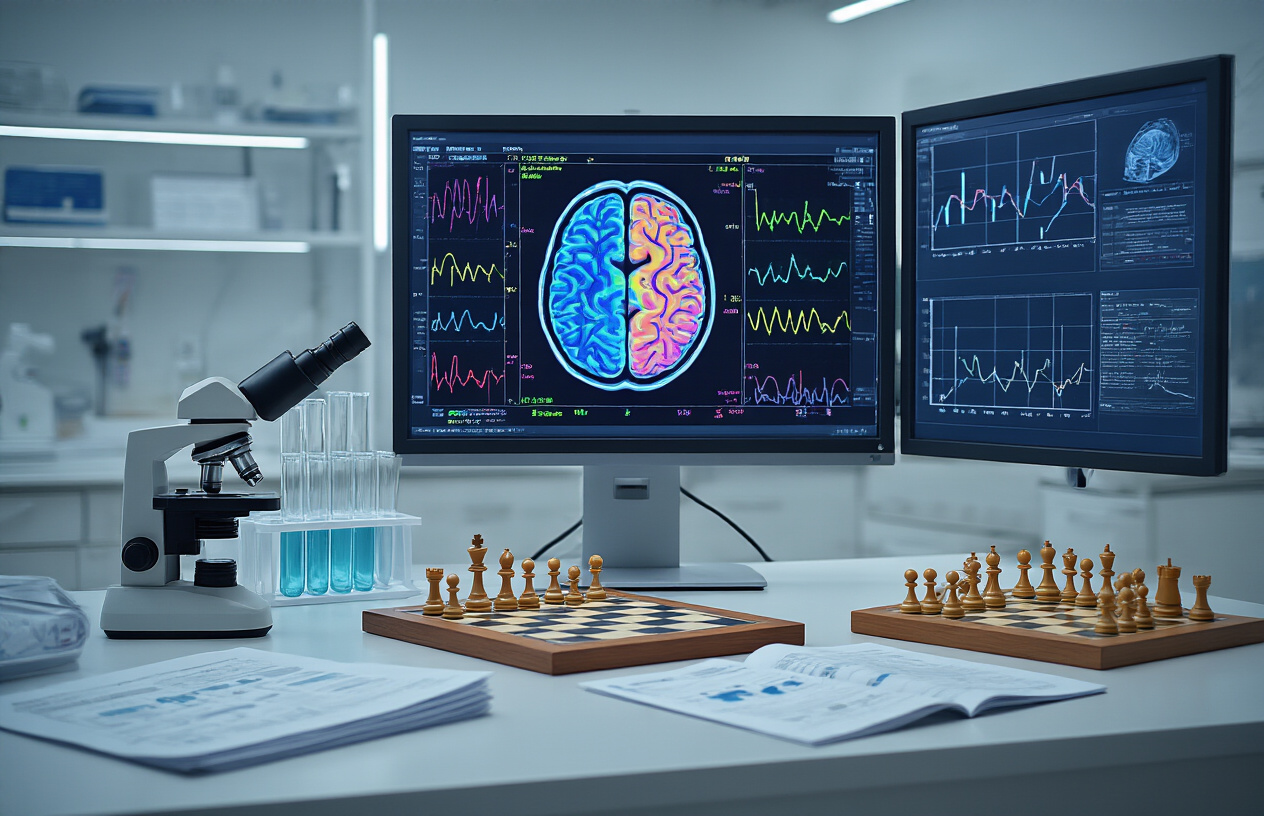
As you read about the benefits of chess for thinking skills, you will find clear evidence of how playing chess regularly can improve your thinking skills. A well-known study done by Sala and Gobet reviewed over 40 research papers and found that chess players always performed better than those who do not play chess in tasks requiring analytical thinking and planning.
Playing chess gives your brain a workout each time you play. This fact has been proven in a study done at the University of Rochester. The study found that chess players scored 13% higher in problem-solving tests than those who did not play chess. The study monitored the subjects for six months and found that those who played chess regularly became better at recognizing patterns and could solve hard puzzles faster than before.
Venezuelan researcher Dr. Margulies did a large study with 4,000 students. They discovered that when kids were given a chess course, they improved in solving math word problems. Chess skills even transfer to real life: it helps you weigh your choices, anticipate outcomes, and think several steps ahead.
The advantage of brain training through playing chess is more visible if considered over long periods. Research done over long periods indicates that practicing chess enhances working memory as well as processing speed, which are important for problem-solving.
Brain imaging today indicates that there are clear differences in the human brain when one becomes a serious chess player. fMRI imaging has found that serious chess players have more gray matter in areas of the brain that deal with visual and spatial skills. The human brain literally re-wires itself to think through complex strategies.
Researchers at the Max Planck Institute used high-tech imaging techniques to scan the brains of chess players. Guess what they found? When you play chess regularly, your neural networks become more interconnected. This allows information to be processed faster. In experienced chess players, the corpus callosum—the bridge between two hemispheres of the brain—is thicker.
The signs of chess intelligence sharpening can be observed through neuroimaging studies that observe the process over time. When you develop your chess skills, more connections are made between your prefrontal cortex and other regions that are used for making decisions. These are highways that can access patterns more quickly and process new information more efficiently.
The brain is also quite flexible when it comes to training with chess, and studies have found that when you perform a PET scan, you can see that the brain is more active in the parts that deal with pattern recognition when you’re not even performing a chess-related function. This is because research into cognitive development in chess has found that it has a transfer effect in the brain.
Comparisons between chess players and non-players on various cognitive abilities are revealing. When standardized test results are analyzed, it has been found that chess players are ahead of their peers in areas such as "memory enhancement," "logical reasoning," and "concentration."
A comprehensive study comparing 100 chess players with 100 non-players found that the chess players had several advantages.
| Cognitive Skill | Chess Players | Non-Players | Performance Gap |
|---|---|---|---|
| Working Memory | 85% accuracy | 72% accuracy | +18% |
| Pattern Recognition | 91% accuracy | 76% accuracy | +20% |
| Planning Tasks | 88% accuracy | 71% accuracy | +24% |
| Attention Span | 42 minutes | 28 minutes | +50% |
Your mental edge derived from chess is not limited to the board. Scientific research has shown that chess players are found to be superior in other mental capabilities:
Memory: Chess players are found to be superior in memory
Attention control: Chess players are found to be superior in attention control
Processing speed: Chess players' fast calculations during chess games are found to be superior
Executive functions: Chess players are found to be superior in planning and organization
Improving chess thinking skills will result in improved academic and professional life. Students who regularly participate in chess games are found to perform better in mathematics and reading. The cognitive skills developed by playing chess games are found to be quantifiable.
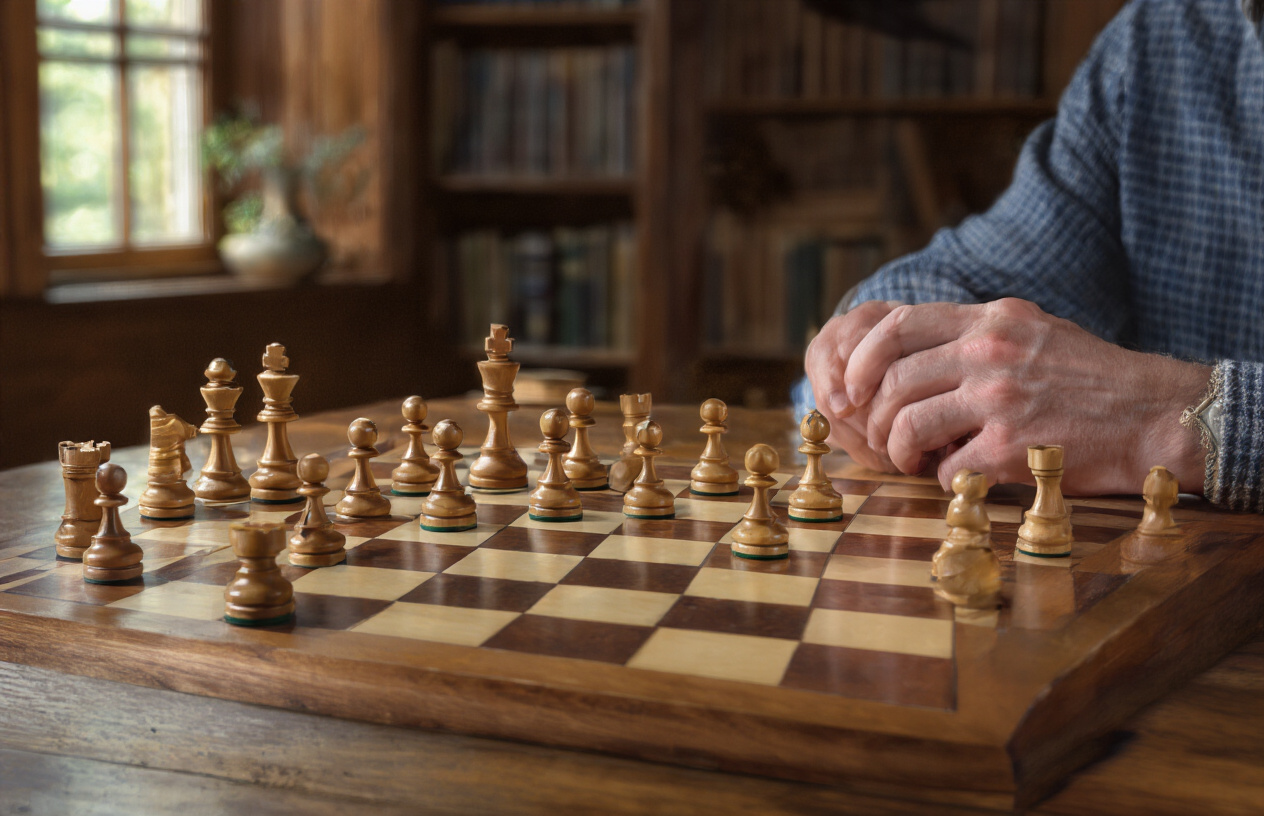
Chess molds you into a natural strategic planner. It forces you to be several steps ahead in your planning and always keep your long-term goals in sight. As you play chess, you are always weighing immediate threats and long-term positional benefits. This trains your mind to integrate short-term plans into a cohesive and overarching plan.
The cognitive benefits of playing chess emerge when you realize you have the capacity to develop multi-layered strategies. You start to develop a choreographed dance of moving your chess pieces in a way that requires 10-15 moves. At the same time, you adjust and respond to your opponent’s strategies. This cognitive flexibility translates well to the real world because you need to anticipate challenges and keep your eye on the ball in all your planning.
In playing chess, you realize that you cannot save all your chess pieces. Similarly, in life, you cannot pursue all the opportunities available. Chess forces you to make strategic decisions that require you to make sacrifices in order to reap bigger benefits.
Regular training on the chess game will train your brain to be pattern recognising and your memory of the game will develop automatically due to the absorption of thousands of chess tactics, combinations and endgames. The end result will be that your brain would develop the ability to recognize such chess strategies automatically.
The more games you play the faster you will develop strategic thinking skills. You will begin to notice repetitive ideas of pins, forks, and found attacks, which will act as short cuts in your mind and you will be able to look at a position and find opportunity to attack quickly. Furthermore, you will improve your ability to visualize, and you will be able to memorize complicated positions on the board and even imagine the further moves without the visualization to the board.
Chess will always test your working memory because it requires you to remember the previous moves of your opponent, the location of the pieces that have moved, and what threats may be posed anywhere on the board. This will enable you to develop high-worthed skills of working memory as you will be forced to handle multiple processing of information in your head.
Chess puts one under a strict training on his/her decision making skills. Every action is a choice that requires the evaluation of various options, the evaluation of risk involved, and the investment in a decision taken. The time limits of competitive play add yet another layer, and players are now taught to make high-quality decisions in a limited amount of time, therefore, evading the dangers of analysis paralysis.
Critical thinking is developed when one learns to question assumptions, and moves more deeply than outward appearances. The expertise in solving problems within chess emerges when faced with the complicated positions that require one to compute the numerous variations, discard the weak ones and find the most promising ones.
Game conditions condition one to be objective in a difficult situation. When faced with a tricky situation or with an imminent time limitation, it is important to leave any emotional feelings behind and focus on identifying the most workable solution. This is a good skill to control our emotions in solving problems, and this is an important competency that is not limited to the chessboard.
Chess is just a natural way of thinking like a mathematician since you do a lot of mathematical calculations and deductions. By working out how much each bit is valuable, whether one side is more in the right than the other and seeing a position through clear reasoning, you become more skilled at the analysis.
You can think rationally better when you learn how to use ideas of if-then. Chess is something that makes you think about a lot of conditions: When I go to here square they may go to there square. but in case they take another step, I may offer a different one. Such progressive thinking will make you easier to stick to logical chains.
Your spatial and geometric thinking is also enhanced by playing chess. You begin to observe the lines that are both diagonally, horizontally and vertically running on the board and you know how pieces relate across these lines. This is space seeing training that can make you better at solving math problems.
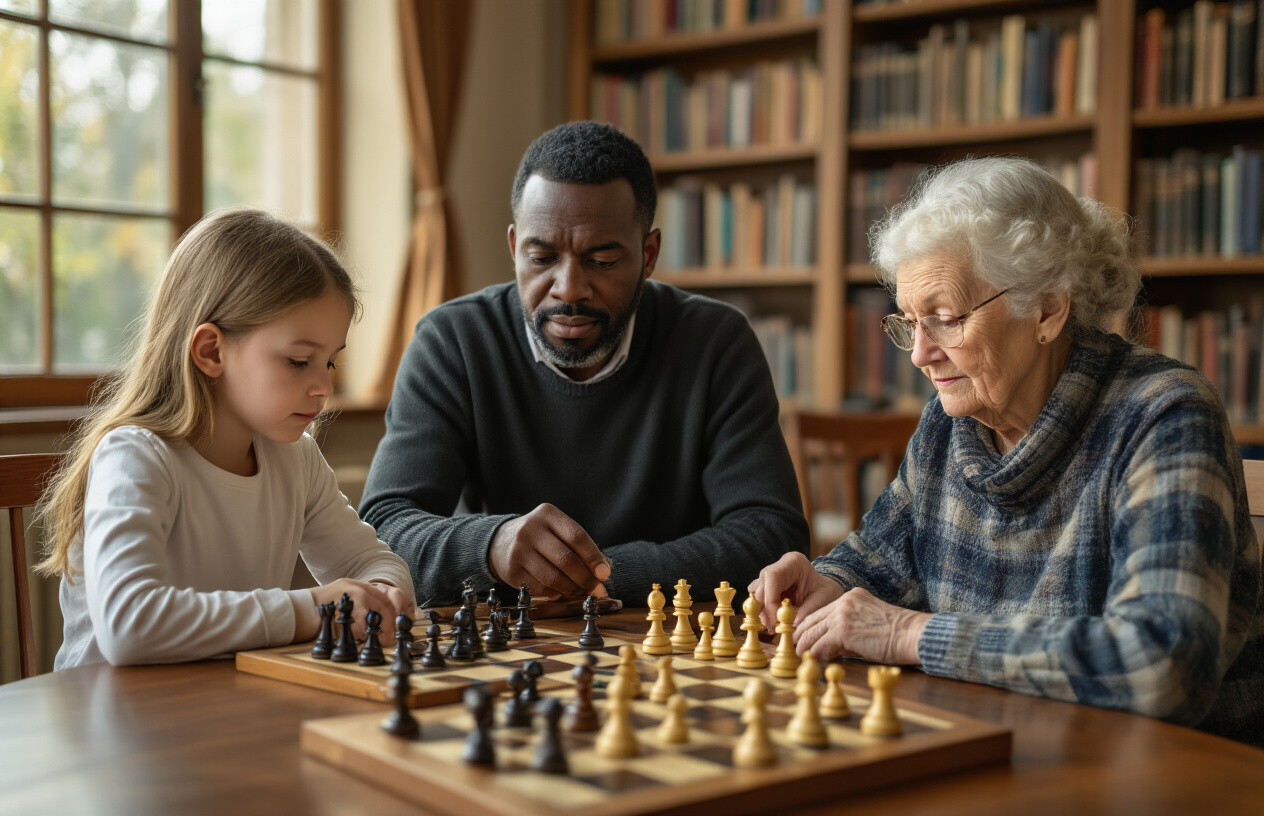
The brain of your child is apt to training in chess, and research indicates that it can be used to enhance schoolwork in most subjects. According to research conducted on thousands of children, the math score can be increased by up to 13 percent and reading comprehension can be increased by up to 10 percent through regular chess lessons. The highest returns occur when you begin at elementary school which is generally between the ages of 6 and 12.
Once a child is taught chess in a progressive manner, he or she acquires a better ability to detect patterns. The skill assists them in solving mathematics problems. Chess also teaches them to think in stages and think logically which enhances the part of the brain that applies to the analytical thinking. It is likely that you will be able to notice that your child is able to concentrate on a greater period of time, and it usually takes a few months of regular play.
Chess also improves memory. Children should be able to recall where pieces are, open moves and think over future moves. This exercise improves the short- and long-term memory. Their brains adapt to process information faster, thus assisting them in performing better in tests and assignments.
Decades-long research involving children who were taught chess versus those who were not, indicate that the highest-achievers involved in chess were much more successful than their counterparts who were not taught chess. They performed better in the tests on critical thinking and their IQ had improved by 3 to 5 points per year at the time of their best learning.
When you become old, playing chess would help keep the brain alert and possibly prevent loss of memory. Research indicates that individuals over 65 years of age who play chess at a regular pace are 40 0 -percent less likely to develop dementia than those who do not play. Chess demands more engagement of the brain than the daily chores do.
Chess is a good exerciser of memory. Any game puts your eyes on the board and your mind on the patterns and tactics and strategies at once. This continuous mind exercise maintains the brain circuits which age the most active.
Chess does not only keep the memory active. Regular playing improves your executive functions, such as flexible thinking, self-control, and the working memory. It has a complete workout to your brain and works on the parts which have the highest probabilities to age.
The safeguard is effective when you continue playing over a long period of time. Brain scans indicate that older individuals who have long played chess retain more gray matter in the memory and decision making parts. When you play chess frequently, your brain keeps on being stronger.
Career demands the maximum level of mental performance and chess training may help one to keep that edge into their working years. Adults between 25 and 65 years old who practice chess regularly show better problem-solving skills and decision-making in stressful situations both of which are highly relevant to work-related issues.
The abstract thinking skills that are developed with chess also come in handy especially in situations that are complex at the workplace. The game conditions people to consider a range of variables at the same time, predict the outcomes of different options, and change the tactics according to the evolving conditions. These skills are easily transferred into project management, strategic planning and leadership.
The ability to process information and the accuracy of those calculations are measured in an incremental way with regular playing of chess. Experiments on working professionals followed over time show that chess players are able to retain higher levels of analytical skills when they are in their 50s or 60s, but their non-chess playing counterparts display a pronounced drop in cognitive skills.
One should not forget about the advantages in managing stress. Chess offers a well-formatted mind exercise which helps in unwinding after a stressful work day but at the same time helping to sharpen the thinking capacity. One literally incorporates relaxation and brain training; a factor that is especially useful when it comes to sustaining optimal mental functionality during career life.
Constant playing with chess also improves pattern-recognition skills in workplaces, assisting the recognition of trends, opportunity recognition, and more effective solutions to problems in the workplace.
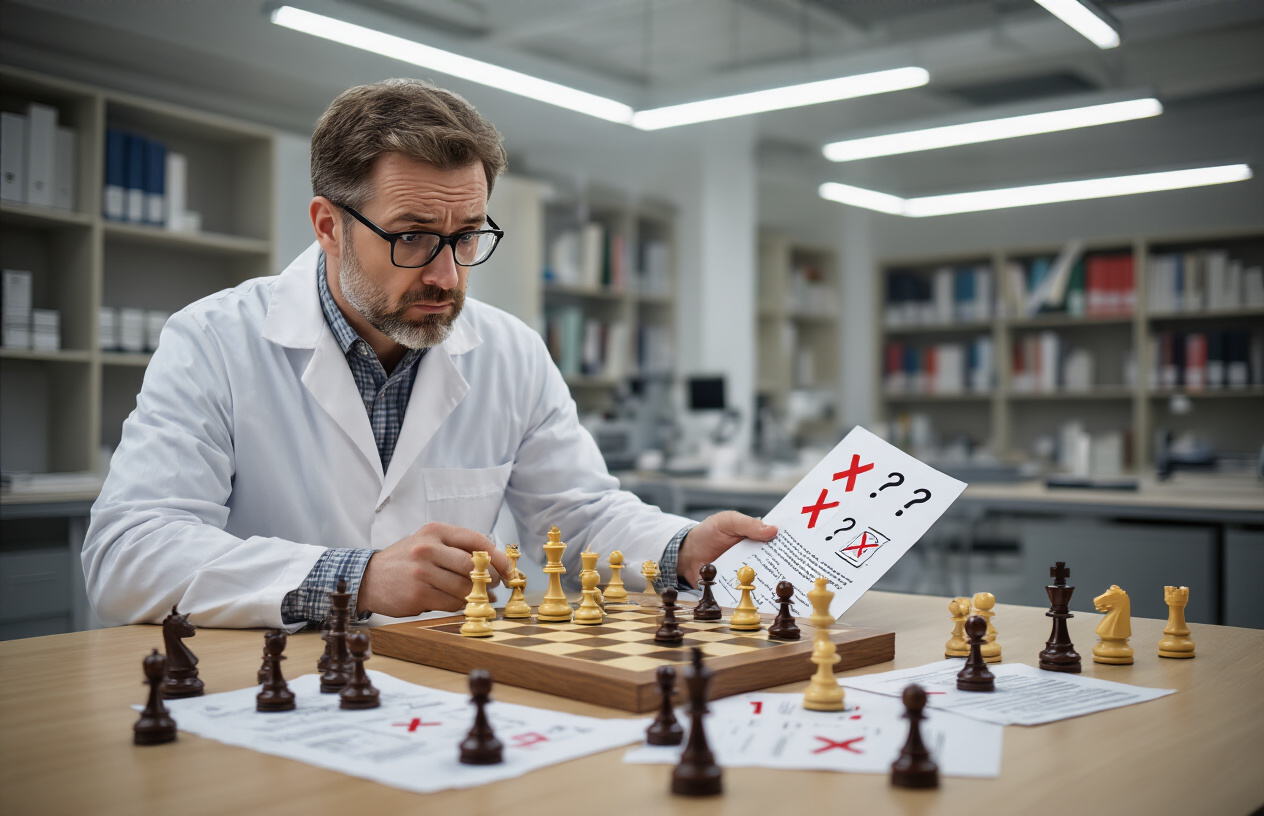
A review of studies on the effectiveness of chess based cognitive training shows that one of the most important controversies is the degree to which skills in chess are applicable in other aspects of life. Even though people can become quite skillful in counting chess moves and identifying the tactical patterns, the data on the transfer of these skills to the real-life problem solving is inconclusive.
Various experiments have shown that chess players are not always better than non-players on general intelligence tests or real-life cognitive tests. Being able to look twenty moves ahead in chess does not necessarily translate into being good at financial planning or making strategic business decisions. The acquired skills seem to be domain-specific, performing well in the context of chess but not generalising well in other situations.
This weakness is especially apparent in the case of chess grandmasters who are not working in their area of expertise. They also have extraordinary analytical powers on the board but they do not always outperform others in mathematical reasoning, verbal comprehension or creative problem solving. The fact that the skills of chess-thinking can be developed is impressive, but it is limited to its own enclave.
The transfer issue is also applied to memory advantages. Even though people can develop a supernatural skill of remembering chess positions and patterns, this is not going to help them remember real-life objects, like the whereabouts of their keys, and does not have a significant effect on academic performance.
If you're considering chess as a tool for cognitive enhancement studies, you need to weigh the massive time commitment against the actual benefits you'll receive. Becoming proficient at chess requires hundreds, if not thousands, of hours of dedicated practice and study.
Consider this breakdown of typical chess learning investments:
| Skill Level | Time Investment | Cognitive Gains |
|---|---|---|
| Beginner to Club Player | 200-500 hours | Basic pattern recognition, improved focus |
| Club to Expert Level | 1,000-3,000 hours | Enhanced working memory, tactical thinking |
| Expert to Master | 5,000+ hours | Domain-specific expertise, minimal general transfer |
When you compare these time investments to other cognitive training methods, the cost-benefit analysis becomes questionable. You could spend the same hours learning a musical instrument, practicing meditation, engaging in physical exercise, or studying new languages - activities that research suggests provide broader cognitive benefits with better real-world transfer.
Your chess memory improvement might be impressive, but you could achieve similar or better working memory gains through targeted brain training exercises in a fraction of the time. The opportunity cost becomes significant when you realize that diverse activities often provide more comprehensive cognitive benefits than intensive focus on chess alone.
Your personality factors are important in deciding whether the mental advantages of chess will indeed come to pass in you. Age, initial intelligence, learning style, and genetic influences are all known to have an effect on the amount of gains that is received after training chess.
Some people are seen to develop the ability to solve chess problems very quickly in a few months whereas others level off after years of practice. Individuals with difficulty in spatial visualization or pattern recognition might not get the cognitive stimulation that others get when playing chess. A cognitive development may be more beneficial with an alternative activity due to the way the brain is structured.
Empirical studies show that children and adolescents show more significant gains of chess training than adults do. When one picks up chess later in life, it would be illogical to assume the same dramatic improvements of cognitive ability that younger players often experience. The brain of an adult though still capable of learning does not have the same level of plasticity and adaptability.
Motivation and the level of engagement are also the determinants of the efficacy of chess related cognitive enhancement. When one sees chess as a burden instead of a fun challenge, the cognitive benefits of the same are bound to be little. The perception of the game has a significant role to play in the realisation of meaningful results of chess mental development research.
The differences in the speed of learning of individuals are also important. Whereas there are players who achieve expert status in a few years, others never reach higher levels of play even when they have spent similar time. The innate ability to play chess is not always linked to general intelligence, thus making it difficult to predict who will gain the most out of the chess training.
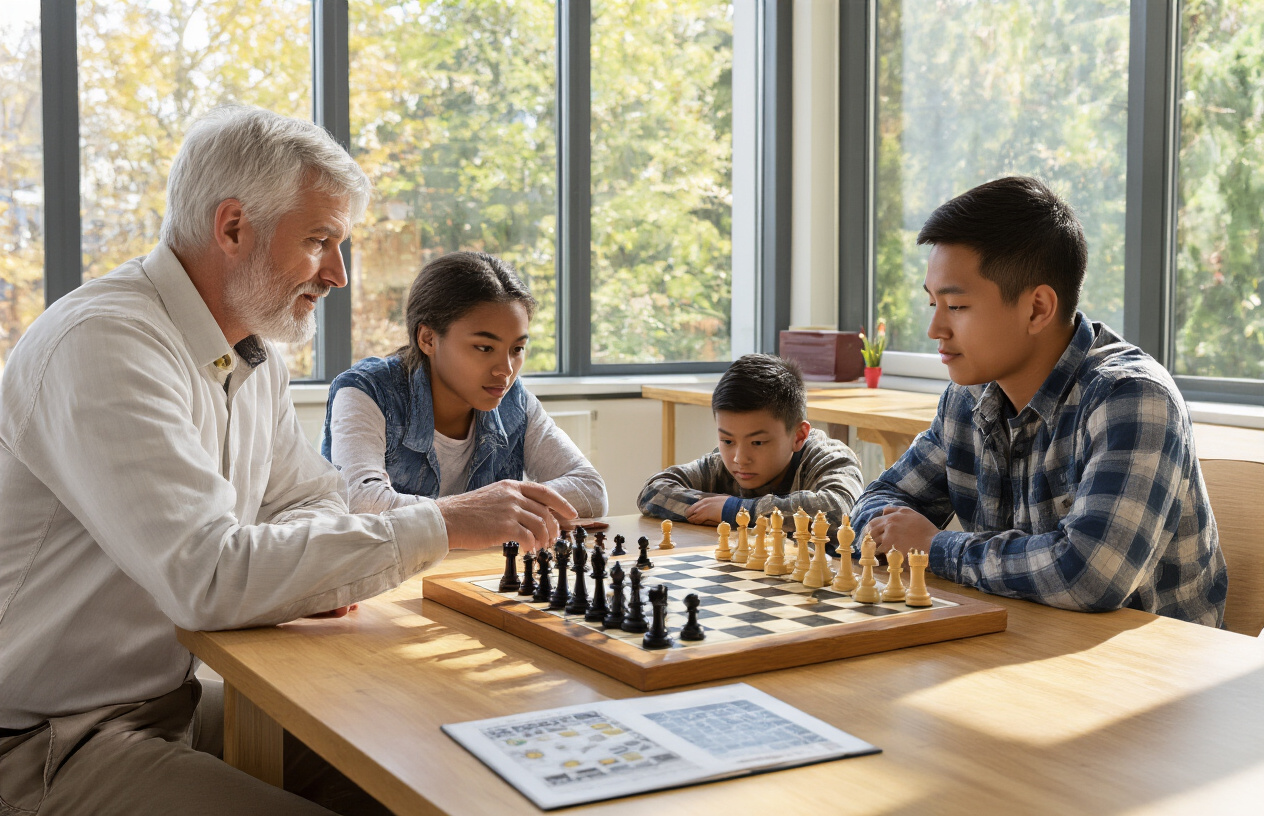
Your brain training on chess is best done in regular and concentrated sessions and not in long marathon sessions. You should strive to have 30-45 minutes of active chess every day, and it will offer your brain enough activity without causing mental fatigue. This is the ideal time to learn new patterns and at the same time you give your brain time to consolidate learning between sessions.
Studies have shown that playing 3-4 games a week with supplementation of tactical puzzles and position analysis, is the best proportion of cognitive benefits in chess. You need to change the type of the games, alternating between short-term matches (10-15 minutes) with long and thoughtful ones (30+ minutes) to develop not only the ability to make decisions quickly but also the deep analytical thinking.
Puzzle-solving sessions of 15-20 minutes should be included in your schedule, and they are specifically aimed at developing the skills of solving chess problems. These short, intensive training sessions are more effective in training pattern recognition than long and unfocused sessions.
Chess memory improvement accelerates when you pair your game with complementary brain exercises. Working memory tasks like N-back training or dual-task exercises create synergistic effects that boost your overall chess thinking skills development.
Try incorporating these combinations into your routine:
Chess + Speed reading: Enhances pattern recognition and information processing speed
Chess + Mental math: Strengthens calculation abilities and numerical visualization
Chess + Memory palace techniques: Improves position memorization and opening repertoire retention
Chess + Logic puzzles: Develops systematic thinking and deductive reasoning
Physical exercise before chess sessions supercharges your cognitive performance. A 10-15 minute walk or light cardio increases blood flow to your brain, making your chess brain training effectiveness more pronounced. You'll notice sharper tactical vision and clearer strategic thinking when you warm up your body first.
Cross-training with strategy games like Go or Bridge challenges your mind in different ways while reinforcing core chess skills. This variety prevents mental stagnation and keeps your cognitive development well-rounded.
Your cognitive development through chess requires structured progression that challenges you appropriately at each level. Start with basic tactical motifs—pins, forks, and discovered attacks—before advancing to complex combinations. This foundation-first approach ensures your chess intelligence enhancement builds on solid ground.
Follow this progression path for maximum cognitive gains:
| Skill Level | Focus Areas | Duration |
|---|---|---|
| Beginner | Basic tactics, piece values, simple endgames | 2-3 months |
| Intermediate | Pattern recognition, opening principles, planning | 6-8 months |
| Advanced | Complex strategies, positional play, calculation depth | Ongoing |
You must start with simple training exercises; the first one-move tactical puzzle, then one two-move puzzle, one three-move puzzle, and finally one multi-move puzzle. This logical development prepares the mind to see deeper patterns, to make a few steps in advance.
Intentionally learn master games by figuring out what moves will be made before they are taken. This kind of practice develops intuitive knowledge and strengthens the brain circuits that account for the cognitive advantages of chess. Choose the games that align with your current level of proficiency: too easy puzzles will not be challenging, and too challenging puzzles will frustrate you in your learning.
Your chess mental development research shows that tracking specific metrics helps maintain motivation and reveals areas needing attention. Monitor your tactical rating on puzzle platforms, recording weekly averages to spot improvement trends. Your rating fluctuations provide concrete evidence of chess cognitive enhancement studies in action.
Keep a training journal documenting:
Calculation depth: How many moves ahead you can visualize accurately
Pattern recognition speed: Time needed to spot common tactical motifs
Endgame knowledge: Percentage of basic positions you can play correctly
Opening preparation: Number of moves you know in your main lines
Monitor your game performance on a monthly basis. The percentage of victories over the players of the same level demonstrates the progress of the ratio of wins to losses. The mean time of your games is the measure of whether you are improving in time management or not. The longer the game, the more you are likely to be thinking more deeply and this is evidence that your analytical abilities are developing.
Simply brain tests that do not involve chess would help to see the bigger benefits. Other ways that chess can make your brain sharper can be revealed through the tests that measure working memory, speed of thinking and problem solving. Take these tests after every few months to objectively measure your progress.
You will not be able to grow steadily, you will have periods of slowness and periods of rapid growth. Note these trends and learn to know how you learn and change your training. There are those who learn tactics fast and strategy slowly and vice versa. Being aware of your own pattern is what makes you know where to put your energy in order to achieve the best results.
The latest information about shipping services and our promotions