

















© 2025 Gurusisya Chess Academy. Designed by Caseyug Groups.
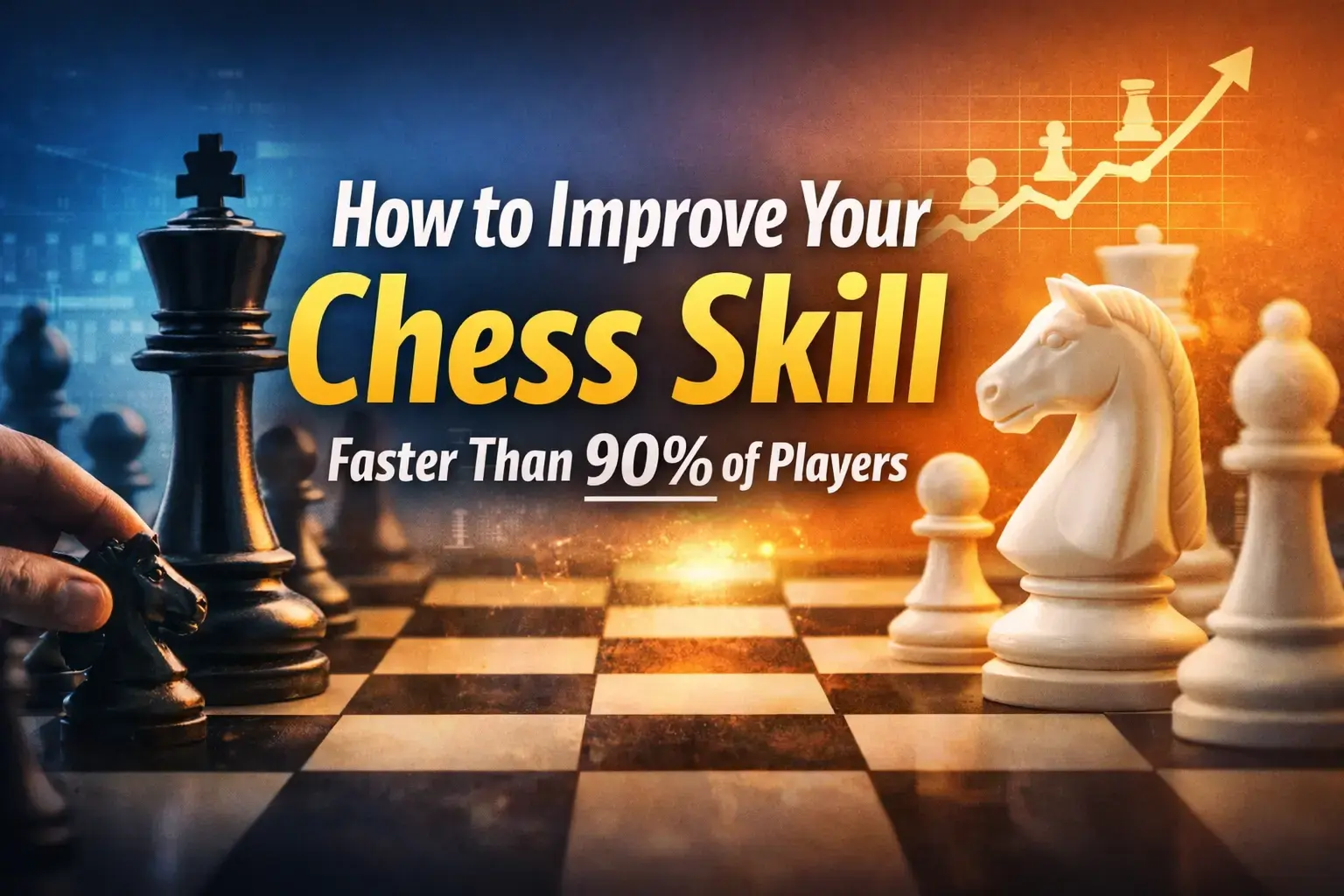
Improving your chess skill is not about talent alone -- it is about how you train, how you think, and how consistently you practice. Many players feel stuck at the same rating for years, not because they lack ability, but because they follow random methods instead of a structured system.
Whether you are a beginner trying to understand the board or an intermediate player aiming to cross the next rating barrier, this guide will show you exactly what to do, what to avoid, and how to grow faster than 90% of players.
Let's dive in.
Before you can improve, you must understand what chess skill actually is. It is not just about remembering openings or knowing famous games.
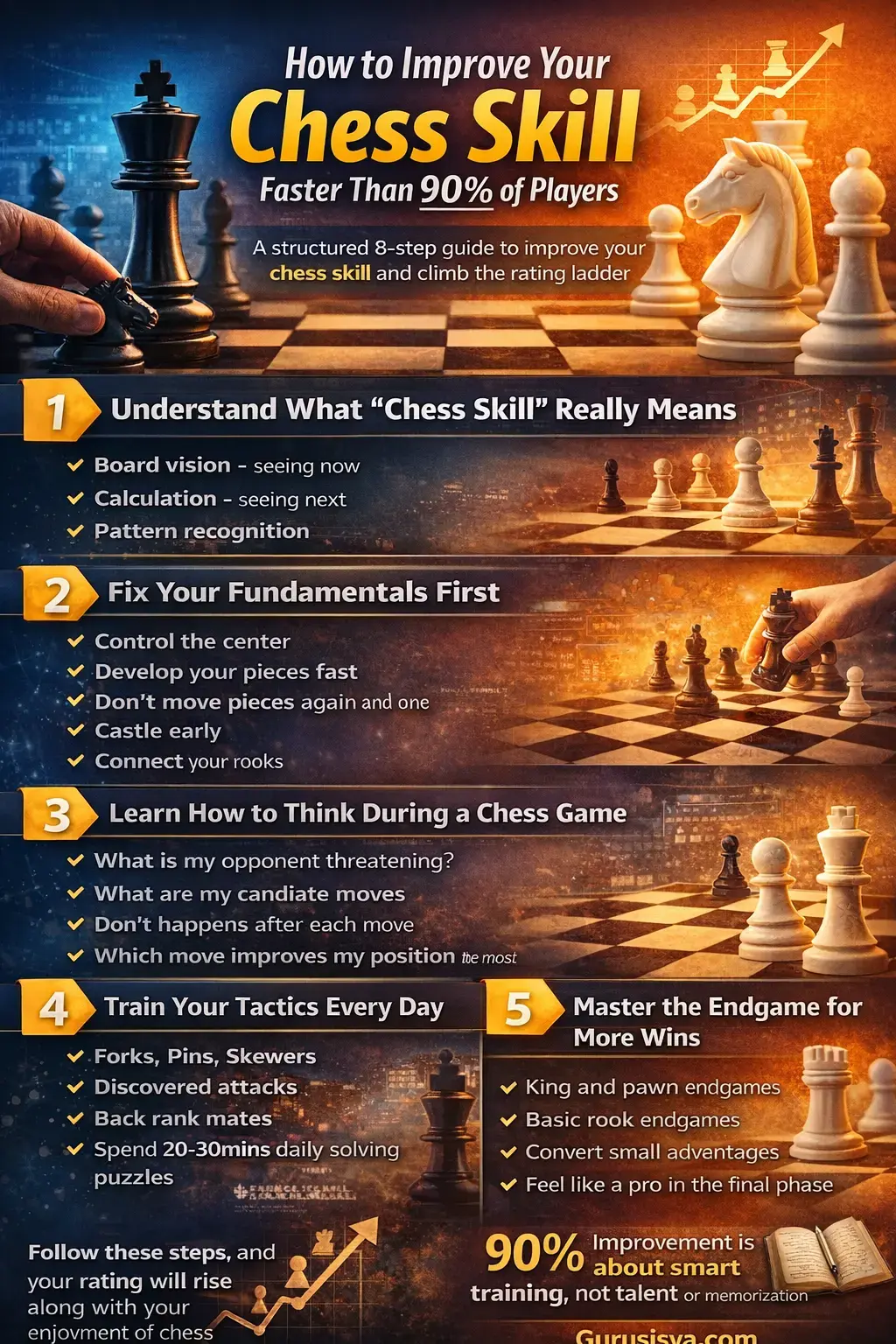
True chess skill is made of five core abilities:
Board vision – seeing what is happening now
Calculation – seeing what will happen next
Pattern recognition – remembering common positions
Strategy – knowing where your pieces belong
Psychology – staying calm and confident
Most players focus only on openings, but openings are only a small part of the game. Real improvement happens in the middlegame and endgame, where thinking matters more than memorization.
If you skip fundamentals, your progress will be slow no matter how much you study. The best players build their strength on simple principles.
Here are the most important fundamentals you must master:
Control the center
Develop your pieces quickly
Do not move the same piece again and again in the opening
Castle early
Connect your rooks
These rules sound simple, but they win games every day. When you follow them, you give your pieces freedom, safety, and activity.
Many beginners lose because:
Their pieces are trapped
Their king is unsafe
Their rook is blocked
Fixing this alone can increase your strength dramatically.
Strong players do not move randomly. They follow a thinking process.
Use this four-step thinking system before every move:
What is my opponent threatening?
What are my candidate moves?
What happens after each move?
Which move improves my position the most?
This habit will instantly reduce blunders. Most mistakes happen because players ignore their opponent's threats.
If you always ask, “What does my opponent want?”, your defense becomes stronger and your attacks become sharper.
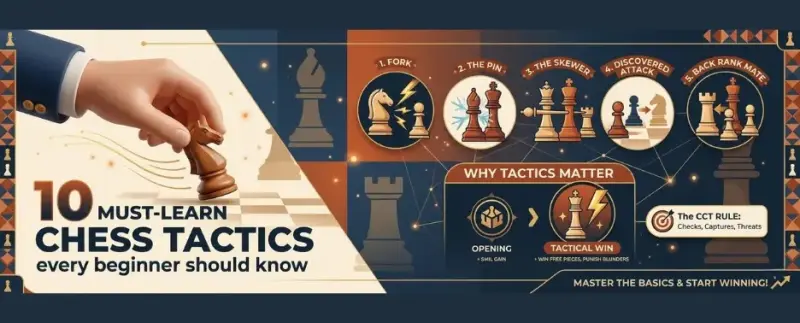
Tactics are the heartbeat of chess. No matter how good your strategy is, one missed tactic can lose the game.
You must train:
Forks
Pins
Skewers
Discovered attacks
Back rank mates
Sacrifices
Spend at least 20–30 minutes daily solving chess puzzles:
Do not rush
Think deeply
Try to see the full combination before moving
When you train tactics, your brain builds pattern memory, and soon you will start spotting winning moves automatically.
This is one of the fastest ways to improve your chess rating.
Most games at beginner and intermediate levels are decided in the endgame. Yet many players ignore it.
You must learn:
King and pawn endgames
How to promote pawns
How to stop passed pawns
Basic rook endgames
Checkmating patterns
When you know endgames, you become confident. You can simplify positions, trade pieces, and convert small advantages into wins.
Strong endgame skill makes you feel like a professional, even against stronger opponents.
You do not need to memorize 30 moves of theory. You only need to understand:
Where your pieces go
Why those squares are good
What kind of middlegame it leads to
Pick one opening for White and one defense for Black. Play them again and again. Learn their ideas.
This gives you:
Familiar positions
Faster development
Less confusion
More confidence
Consistency beats complexity every time.
Playing without analysis is like running without tracking your progress.
After every game:
Find where you made mistakes
Understand why they happened
Look for missed opportunities
Save important positions
Use engines only after you try to analyze by yourself. This builds real understanding.
When you do this, your mistakes stop repeating, and your improvement becomes steady and permanent.
Blitz is fun, but it does not build deep thinking.
To really improve, play:
Rapid games (15–30 minutes)
Classical games
These allow you to:
Calculate
Think
Plan
Learn from mistakes
Fast games only train reflexes. Slow games train your brain.
Study games from strong players. You will learn:
How they attack
How they defend
How they simplify
How they win
Watch how they place their pieces and how they improve their positions step by step.
This gives you chess intuition, something no engine can teach.
Chess is also a psychological battle.
You must learn to:
Stay calm after mistakes
Avoid tilt
Stay focused for long games
Trust your calculation
Confidence grows when you train properly. When you believe in your thinking, your moves become stronger.
Here is a simple routine you can follow:
20 minutes – Tactics
20 minutes – Endgames or strategy
1–2 games of slow chess
10 minutes – Game analysis
Do this daily, and your chess will improve faster than you imagine.
Consistency beats intensity.
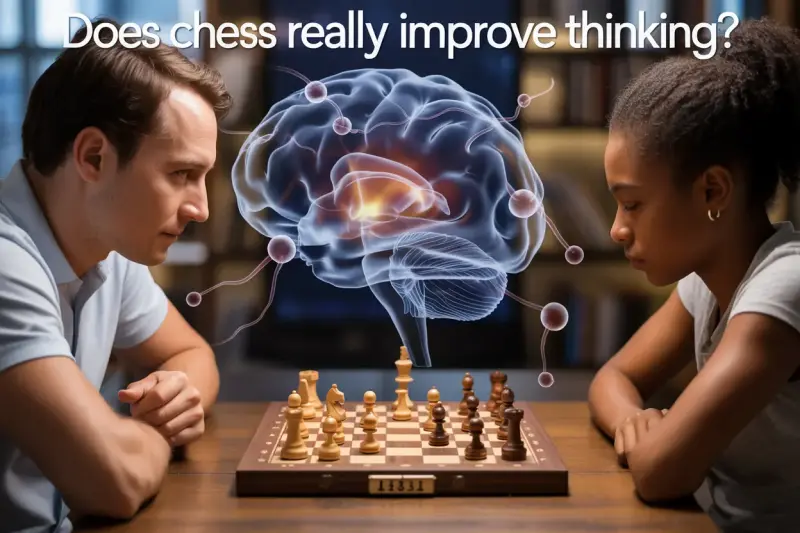
Chess improves:
Memory
Focus
Decision-making
Patience
Creativity
Every game is a mental workout. Over time, you will think more clearly not only in chess, but in real life too.
Improving your chess skill is not about shortcuts. It is about smart training, disciplined practice, and clear thinking. When you focus on tactics, endgames, and real understanding instead of memorization, your improvement becomes unstoppable.
Follow the methods in this guide, stay consistent, and you will see your rating, confidence, and enjoyment of chess rise together ♟️
The latest information about shipping services and our promotions